
Sweaty Lamarr’s rendition of Infidelity’s 5 stages of grief
“I really love stories that take place in the minds of really screwed up women.”
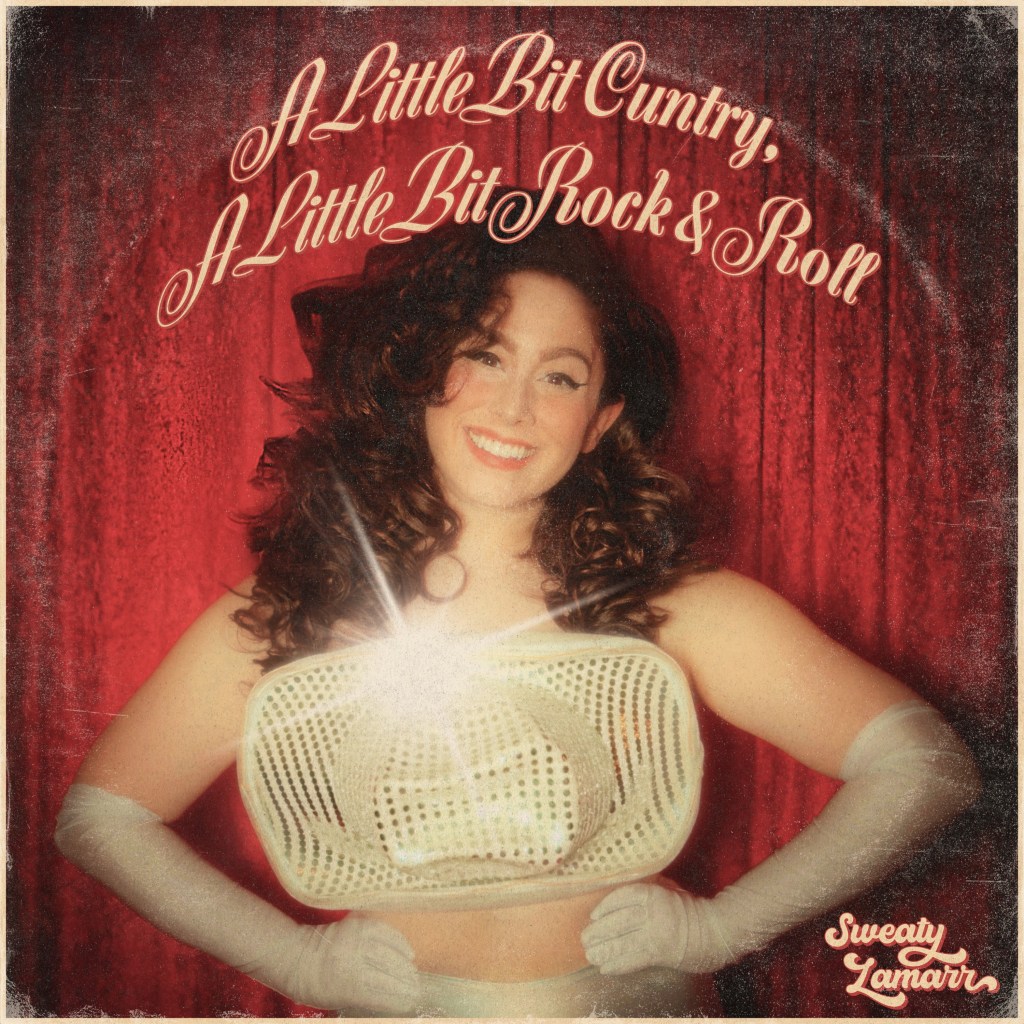
On 8 July, Sweaty Lamarr released her first EP, A Little bit Cuntry, a little bit Rock & Roll, and it’ll make you think twice about underestimating women.
“I was writing a lot about infidelity from different perspectives. And this whole EP, every song talks about infidelity in some way,” Lamarr says. “I wanted to really explore different spaces, and this album came together really unexpectedly. I offered Abbey [I’m Sorry I Stole Your Man] as the first single, and then I realized I should offer up a couple more and I had these songs and they very luckily wound up all being about infidelity.”
The EP was produced by Lovegrove studios, arranged by Sam Roller and Van Isaacson, mixed by Hayden Tumlin and mastered by Cameron Row — with Mel Johnston and Kim Foxen joining in on “Brass Ring” as featuring background vocalists.
The collection of songs flows perfectly with the mood the artist intents to set, which is the confusing, all-over-the-place sense one gets when either participating in the act of cheating or being the one cheated on.
“I feel like there are a lot of emotions that you feel when going through infidelity,” she says. “There’s that euphoric rush, weirdly, that people feel when they’re cheating, like that rush of hiding in the broom closet and the “we might get caught and we might not.” There’s heartbreak. There’s rage. There’s sadness of figuring out logistics “who’s moving out, who’s getting the house, who’s getting the dog, who gets the friends.” And then eventually stepping away from that mentality of being that other woman, and learning about yourself. I hope that with these five songs, that I’ve tapped into some part or some parts of this event that we don’t talk about cause no one wants to be like “I’m writing as the other woman.” Well you know what, I’ll do it, I’ll write as the other woman, why not? It’s something interesting, it’s something taboo. Maybe poke around a little bit, maybe cause a little controversy and that’s how I roll.”
Which was the main precipice with “Abbey I’m Sorry I Stole Your Man” being about Dolly Parton’s infamous Jolene’s response to the country singer’s plea not to steal an already married man.
“I really like these dark, conflicted, complicated women,” Lamarr says. “That’s something I relate to probably too much. So I felt a calling to be the woman who is being a little evil or bad, but I also wanted to expand on those women. And not just be “oh she’s the vixen who stole the guy.” Cause honestly I could honestly write a song about Jolene being like “Listen Abbey you weren’t hot, so I got the guy.” But that didn’t excite me. She’s bad. Why? There are times when we don’t really need to know why and times we do.”
The EP setlist is as follows:
- Abbey I’m Sorry I Stole Your Man
- Brass Ring
- Both Feet
- It Wasn’t God Who Made Honkey Tonk Angels
- Both Feet (Clean Version)
Each song feels, as the artist mentioned, like a different way to tackle infidelity. But more so, like Lamarr is talking to a different person is every track.
In the first one, also the first single she released on 10 June, she is the other woman talking to the scorned woman, explaining her actions and making her case. An olive branch extended to join forces against the man, rather than pitting women against one another — as it usually is.
In “Brass Ring,” it feels like she is picking the fun out of the unfaithful man in front of an audience, making him the butt of the joke rather than her, as it is most often the case with infidelity. Rather than being laughed at for being cheated on, she is laughing at the man for “tossing aside the band of gold to grab a brass ring” not realizing what he had to begin with, and giving it up for the thrill of being unfaithful.
“Dorothy No More” hits it where it hurts.
Lamarr’s second single came out on 1 July.
It’s a woman picking herself up after the hurt has been done, and figuring out where she goes from there. It’s a woman talking to her cheating partner, with scorn dripping from her voice at the irreparable damage that has been done, but make no mistake — she does not attempt to fix it herself.
That song, as was the case with most of the EP, was a new experience for the singer in a lot of ways. Mostly because, she was not writing from personal experience.
“This was based on situations I observed, and being cheated on is a pretty universal concept,” she explains, “and I was happy to write about something that feels pretty universal, I can make it feel specific. I can tie it to something that everybody loves which is the Wizard of Oz. So this was exciting for me as a challenge to write something more radio friendly, more general and to write outside of my own experience.”
She argues for both writing from personal experience and writing from outside observation, but that while tapping into one’s own experience might be easier access to emotions while writing/recording, “Dorothy No More” was one of her most emotional studio performances yet.
“Because I worked really hard on it,” Lamarr says. “And I worked on summoning a lot of things that made me feel a certain way, and tried to bring that into the studio. Something I’m working on as a goal, is to write outside of my own experience. That’s something I wanna work on because I feel it will make me a stronger writer, and it will open up the possibility for these songs to be covered more easily. For me to be hired to write a song for something else, which would be a huge goal for me. The fact that I have this song that wasn’t even about me feels like a huge accomplishment and I feel very proud that I was able to do that but also that people really resonate with it. There is the difficulty of being able to conjure up specifics that I cannot take from my own memory.”
“Both Feet” taps into those morally grey women the artist strives to give voices to. It feels like the entire thing is happening over a late night phone call from a former lover, whose current partner is in the other room, and the woman on the line (the other woman) is tired of this repetitive pattern. It feels like she cannot indulge it any longer, nor does she wish to be pitted against another woman. It’s a woman putting a man in his place, even though she may not be so innocent herself.
“It’s the story of an ex of the protagonist,” she says. “And the protagonist, you can tell, she was someone who indulged this behavior before. Maybe she was the other woman, maybe she was the enabler of some kind, maybe she was the person this guy had a rebound with and then she graduated. So she still, she is not gonna tell the girl that this guy is cheating. Which is a little questionable, because some people would want her to while others would be like it’s not her business. But she’s like a little fucked up but she’s growing. And I think that’s more interesting than a guy writing a song about he got mad bitches on the side.”
“It Wasn’t God Who Made Honky Tonk Angels.” The title seems familiar because it is. Originally, the song was written by J. D. “Jay” Miller, and recorded by Kitty Wells. Over the years, it was covered by a number of artists, namely Dolly Parton, Pasty Cline, Loretta Lynn, Tammy Wynette. And now, Sweaty Lamarr, with a Rock’n’Roll spin.
Where the previous four had an intense country feel to them, from the heavy deep honky-tonk feel of “Abbey I’m Sorry I Stole Your Man,” the joyful beat of “Brass Ring” that’s the kind you find a way to line dance to and clack your boots to the rhythm, to the sad country ballad of “Dorothy No More” and “Both Feet” reminiscent of Taylor Swift’s early work (Lamarr admitted to drawing inspiration from “Fifteen” from Swift’s studio album, Fearless), “It Wasn’t God Who Made Honky Tonk Angels” is pure head-banging material.
It’s an angry woman’s howl, and although it is followed by the clear version of “Both Feet,” it can also be seen as the perfect way to seal the EP — especially with that abrupt end after Lamarr’s scream. While it starts with Jolene making amends for her actions, it comes full circle to her, or any other woman who’s ever been deemed as the slutty mistress, pointing the finger back at the cheating man who should not be laid off the blame.
“We watch TV shows or movies where men do bad things, or morally questionable things, or illegal things and we question whether these things should even be illegal,and we question whether they should be seen as bad,” Lamarr says. “And I think that instead of being like “oh women are these perfect angels,” we could be more open to saying that there is good and bad in all people. We want real portrayal of real people with real problems. I never think evil is just evil. Unless you’re a sociopath. I think we have so many antiheroes that are men, like the Joker or Walter White from Breaking Bad, that are allowed to be bad and we also get a nuanced understanding of what made them that way and how they might be good. And I’m very fine with women having that same playground.”
 Busybee's Playlist
Leave a comment