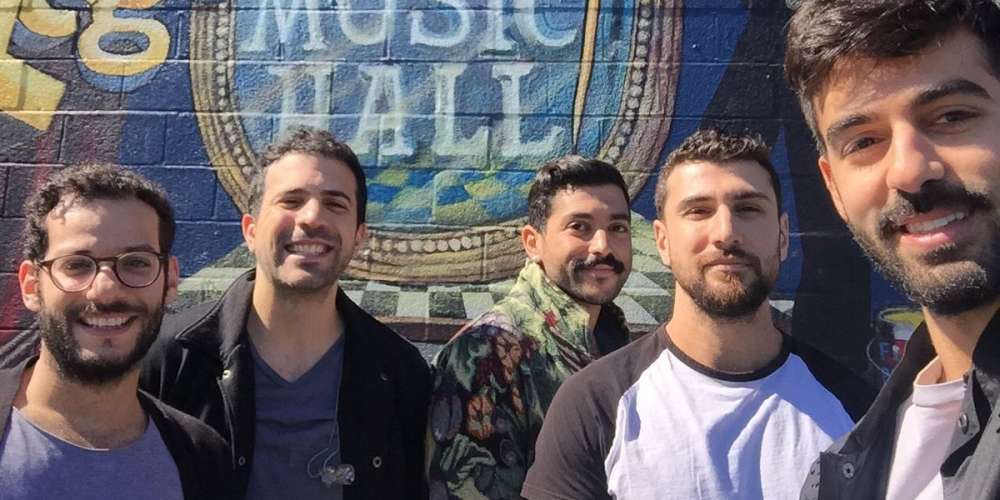
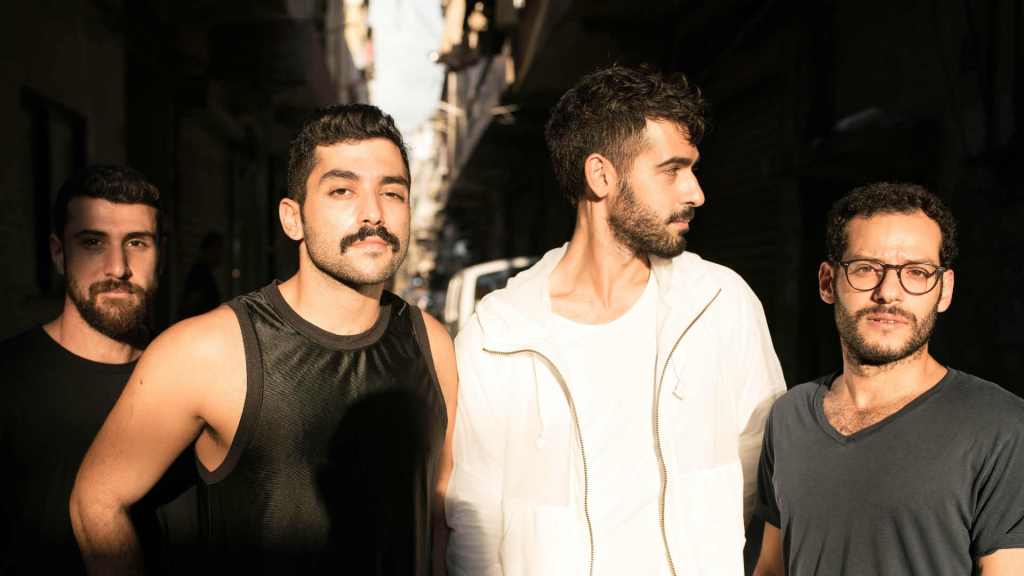
After 14 glorious years, Lebanese Indie Rock band Mashrou’ Leila dismembers.
https://hornet.com/stories/mashrou-leila-lebanese-band/
We grew up with our parents’ music.
Music ranging from the Rahbani brothers (Assi, Mansour and Elias), to Fairuz, Sabah, Oum Kalthoum and Ziad Al Rahbani’s (Assi and Fairuz’s son) satirical and brilliant plays.
We grew up hearing that this was real music and talent like theirs can’t be seen anywhere else.
To a certain extent, they were right.
They were akin to the West’s appraised 1960s and 1970s Rock music artists, decades from where the Boomer and Gen X generation can’t seem to grow out of.
But for some of us, the aforementioned Arab legends didn’t speak to us. For the most part, we couldn’t really identify with the lyrics that were sung or the issues that were raised in their songs. Granted, they still rang true in many ways but the essence of the problem was: they didn’t sing for our younger generation.
Enter: Mashrou’ Leila.
A serendipitous meeting between (initially) eight AUB (American University of Beirut) students, a local furn (bakery where mostly manakish and baked goods are served) where Leila was the main muse lead to an “Overnight Project” (literally translation of Mashrou’ Leila) — and a beacon of hope for Lebanese youth.
Original members consisted of Haig Papazian on violin, Omaya Malaed on keyboard, Andre Chedid on guitar with Hamed Sinno, Firas Abou Fakher, Ibrahim Badr, and Carl Gerges joining in later respectively on vocals, guitar, bass and drums.
The band later on went from an eight-piece to a five-piece with Mashrou’ Leila becoming what we now know them as Hamed Sinno (frontman, vocalist), Firas Abou Fakher on guitar, Haig Papazian on violin and Carl Gerges on drums.
I began listening to Mashrou’ Leila when I was 16, and the first song I was introduced to was the notorious “Imm El Jacket” (translates to “Remove the Jacket”) from their EP El Hal Romancy (The Romantic Situation).
A comic relief that follows another very popular sad ballad titled “Inni Mneeh” (I’m Alright), Imm El Jacket is a nice play on gender pronouns —something very common in the Arabic language where verbs are conjugated to fit the gender they’re speaking to, and gender expression.
Imm el jacket w l bantalon
Cheftik we2fe fo2 l balcon
Khammantik chabb ya mademoiselle
La twakhzini pardon
Take off the jacket and the pants
I saw you standing on top of the balcony
I believed you to be a man, mademoiselle (miss)
I beg your pardon, i’m sorry.
I remember being blown away by the homogenous nature of the slang words and oriental flair of the music — and how much I loved it.
Modern Arabic music was mostly just a mix of irritating organ notes with a male voice lamenting about a woman who goes out too much, and wears skirts too short to be considered a proper housewife. Safe to say, I wasn’t always a fan.
But in the case of Mashrou’ Leila, I found myself hungry for more. I looked them up, and scoured for more songs.
Their 2013 album Raasuk (They Made You Dance) caught my ear, when I listened to the poignant “Lil Watan” (For the Country) — a dig at the Lebanese National Anthem lyrics Koulouna Lil Watan (All of us for the country.)
“Lil Watan” plunged me further into my devotion to the local band, and made me want to know more about them. The satirical nature of the song — a mix of intense lyrics and dancing tunes as a blatant insult of the Lebanese government and political parties made me feel represented — for music has always been and always will be my preferred way to revolt.
Aalamouk l nashid alo sira3ak moufid lil watan
Khadarouk bel warid alo khoumoulak moufid lil watan
They taught you the national anthem
They told you your struggle is useful
For the Country
They drugged you through the vein
And said your idleness is useful
For the Country
A deeper look into the band’s principles made me stumble upon a beautiful revelation: frontman Hamed Sinno was openly queer, and a fierce LGBTQ+ activist. Not only that, but the entire band has been known to make their concerts a safe space for LGBTQ+ folk.
A song like “Shim El Yasmine” (Smell the Jasmine) from their 2010 debut album Mashrou’ Leila has become an anthem for the Lebanese queer youth, as Sinno’s words were those of a lover in pain mourning the end of a relationship with another man.
In 2015, another breakup song titled “Falyakon” (Let it be) from their album Ibn l Leil (Son of the Night) is a lighter spin on heartbreak, where Sinno again does not hide that it was from another man.
Of course, Mashrou’ Leila’s provocative nature did not come without their share of adversity from the MENA region.
From show cancellations to complete banning from certain countries, the band’s lyrics as well as blatant disdain for discrimination in all its shapes and forms were cause for a lot of controversies, as well as abuse, in countries where a lot of human rights remain violated.
And unfortunately, the consistent hate and abuse lead to Mashrou’ Leila putting down their arms, exhausted and drained.
“[The online harassment] made us feel very pressured,” expressed Sinno on the Lebanese podcast “Sarde After Dinner” on 11 September, with Médéa Azouri and Mouin Jaber. “We couldn’t continue working and creating like that.”
In a Guardian article earlier this year titled My band was silenced in the Middle East. But a global queer community gives me strength, violinist Haig Papazian wrote:
“Since we formed in Lebanon 10 years ago,” Papazian said, “Our music appears to have created ongoing controversy as an indie rock band that has remained unwavering in support of queer rights and criticism of Lebanese society and politics.”
For me, Mashrou’ Leila wasn’t just a beacon of hope for Lebanese Youth because of their queer openness and strong support to the LGBTQ+ cause.
It was a modern, beautiful and youthful expression of rebellion against the intolerance we grew up in; in Arabic.
In a language that the Lebanese youth was taught to reject and see as a “dirty” language — be it from their own parents, or the French/English schools they went to.
We’re not taught to love our mother tongue yet are expected to be connected to it and call it as such.
We’re not taught to speak it properly, yet are ostracized when we struggle to express ourselves in Arabic beyond the basic and swear words.
Modern Arabic music does not tackle issues we are familiar with, or express what we really feel, yet we’re made to feel bad if we refuse to listen to it.
But Mashrou’ Leila’s music gave us a place of refuge, a respite if you will.
It made us feel like there is a place for us. Those of us who have no place in typical Lebanese society, but still would like to feel a part of something within it.
،رقصتوني، بكيتوني، وضحكتوني. ولا بأحلامي رح إنساكن, مشروع ليلى.
 Busybee's Playlist
Leave a comment