Answer the war call for a Free Palestine
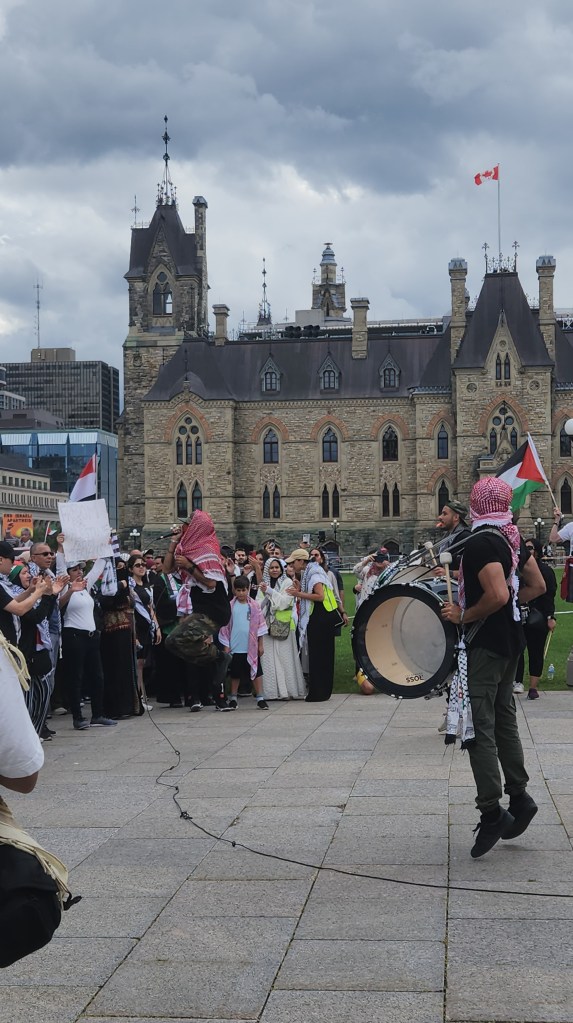
Downtown Montreal is no stranger to strong, loud sounds. After all, the city’s symphony is a mix of car horns, sirens, and construction drills with an added bonus of snow removal during the winter months.
This past year, however, every Sunday at 2 PM, a resounding roar overtakes the streets in the form of powerful chants and booming drum beats.
DUM DUM DUM DUM GAZA
DUM DUM DUM DUM RESISTANCE
A year ago today, following what is now being dubbed as “Al Aqsa Flood” on 7 Oct. 2023, passionate crowds led by a steadfast and dedicated organization started relentlessly protesting every week.
Montreal4Palestine (M4P) is a multi-generational community-based movement fighting for the total liberation of Palestine through awareness & education.
Founded in 2021 under the name “Canada Sanction Israel,” this grassroots organization is the result of a group of friends meeting in a Montreal protest for Palestine, around the time the forced eviction of six Palestinian families was happening in the occupied East Jerusalem neighbourhood of Sheikh Jarrah in May 2021.
“There was a lack of unity and presence for Palestine within the streets of Montreal,” says Mahmoud Khalil, one of Montreal4Palestine’s founders. “We came together as a group of friends with a set of demands, and one of them was for Canada to apply sanctions on Israel. We started coming together week after week.”
Over the years, the organization’s methodology changed with the objective and message evolving yet at the same time, remaining the same.
“It was an individual effort from a bunch of different individuals, but a collaborative efforts movement,” says Khalil. “We came together, we put everything that we had. We were able to move the people, get them going and participate in protests as well as different types of actions for Palestine. We got them to raise the flag of Palestine all over Montreal.”
“We’re committed to sharing the real Palestinian message across Canada,” Khalil continues, “following the non-negotiable principles of the Palestinian people and without hiding their true identity. We are openly resistance-oriented and supportive.”
By the time 8 Oct. 2023 rolled in, and the ongoing aggression and genocide began in Gaza, M4P was fully equipped to hit the streets and protest on a weekly basis, quickly becoming a solace to the people who needed an outlet to express their anger and grief.
“Watching all these scenes of children dying, and people being cut up or left under the rubble, being removed from under there, dead or alive,” Khalil says, “people needed a safe place to direct their anger. And Montreal4Palestine provided that safe place for them to voice their rejection of the ongoing genocide and the complicity of the Canadian government in it.”
To this day, M4P’s demands remain true to their original objective: enforcing an arms embargo on Israel and sanctioning the State economically and politically.
While weekly protests recently became a constant for Montreal4Palestine, the grassroots organization has always made sure to have an action dedicated to Palestine since its inception. Week on, week out, banner drops and cultural events occurred to raise awareness and keep the conversation about Palestine going.
“I definitely see the change that’s happened throughout the years,” Khalil says. “A change in, for example, the amount of people that join us on the streets, the amount of trust that we have in our community, and also the readiness of the team to take on any challenge and be at the forefront of the Palestinian fight. To actually lead all of Canada in protesting and being one of the first teams to always respond and be there.”
Echoes of solidarity can be heard throughout Canada as well, with the M4P message expanding to cities like Toronto, Ottawa, Waterloo, and even Milton.
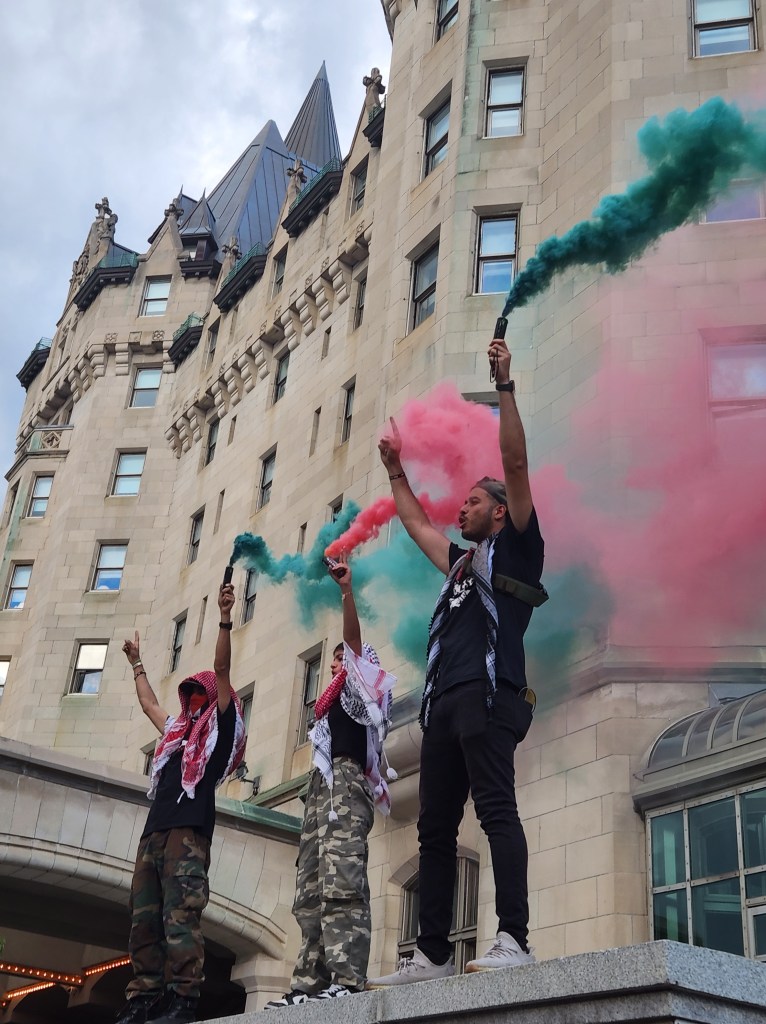
“We are the community,” Khalil says. “We don’t have any funding. Over the years, and over the different experiences that we’ve had, we were able to build ourselves. We are now at a place where we are capable of independently going out without any support. Montreal4Palestine is a full team in and of itself.”
Weeks on the streets allowed M4P to learn from itself and study what people respond to when protesting. Chants became catchier, the rhythm evolving with the protestors, and chanters updating their words in solidarity with the situation in Gaza and all over Palestine. The rallying calls are always in three languages, in keeping with the bilingual nature of Montreal (English/French), and the Palestinian mother tongue (Arabic.)
One cannot deny, however, that demonstrations were truly elevated when drums were introduced.
“By the end of 2023, we began introducing [the drums] and they’ve made a great change,” says Khalil. “We started off with one drummer that used to join us often and he was the only one back then, but that’s quickly changed and today we have a whole set of drums for the team that we’re able to utilise whenever we want and however we want.”
Drums are a magical instrument that seems to boost any situation they are included in. One of the most obvious reasons being that they are loud and imposing – qualities required, and preferred in protests.
According to an article from http://puppetista.org/drums/, “[With the help of drums] Marches and demonstrations become livelier, more aggressive, more confrontational, and more fun. Drums say “No Business As Usual!” and “Let’s Dance!” in a universal language. Sonic disruption can raise the stakes of demonstrations, legally and nonviolently. Fellow demonstrators are encouraged by the beat, enlivened by the syncopation, and inspired to dance past mounted police into the streets.”
While chants, when worded right, can be just as disruptive and provocative, they’re only as loud as a chanter’s vocal range. However, when paired with the right drummers, an auditory synergy happens, raising the vibration, elevating the roaring of the crowd, and ultimately giving both leaders and followers a strong sense of power.
“When I chant, I live the moment,” says one of the prominent chanters of Montreal4Palestine, and a crowd favourite. “My chants come naturally, I don’t fake anything. Every word I say, every chant I say, I live it, I live every single word. Alhamdulillah, I have the ability to connect with the crowd, I put myself in their shoes, and I feel where there is kind of a low vibe and I want to hype them up. You want to give them the feeling that we need to build off each other’s energies. And the same goes when I chant alongside drummers. Whenever I need a specific beat that goes with a chant that I feel is rising in me, I let them know first to keep quiet so I can hype the crowd up and connect with them, and then I let that shift with the drummers, and it just works.”
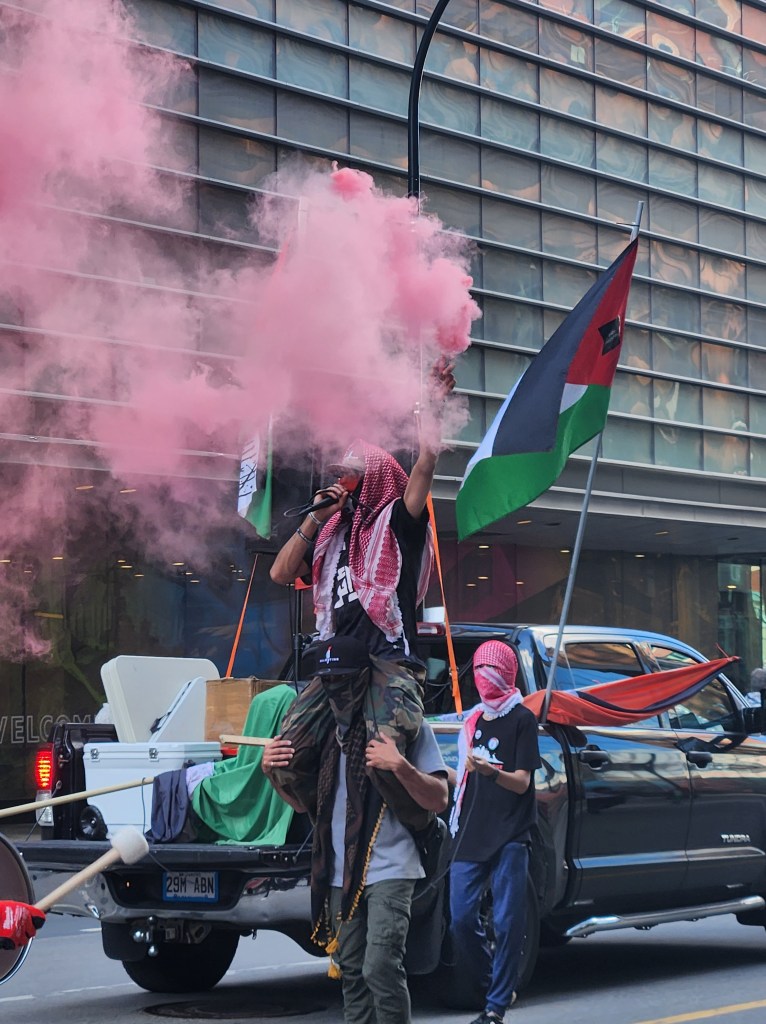
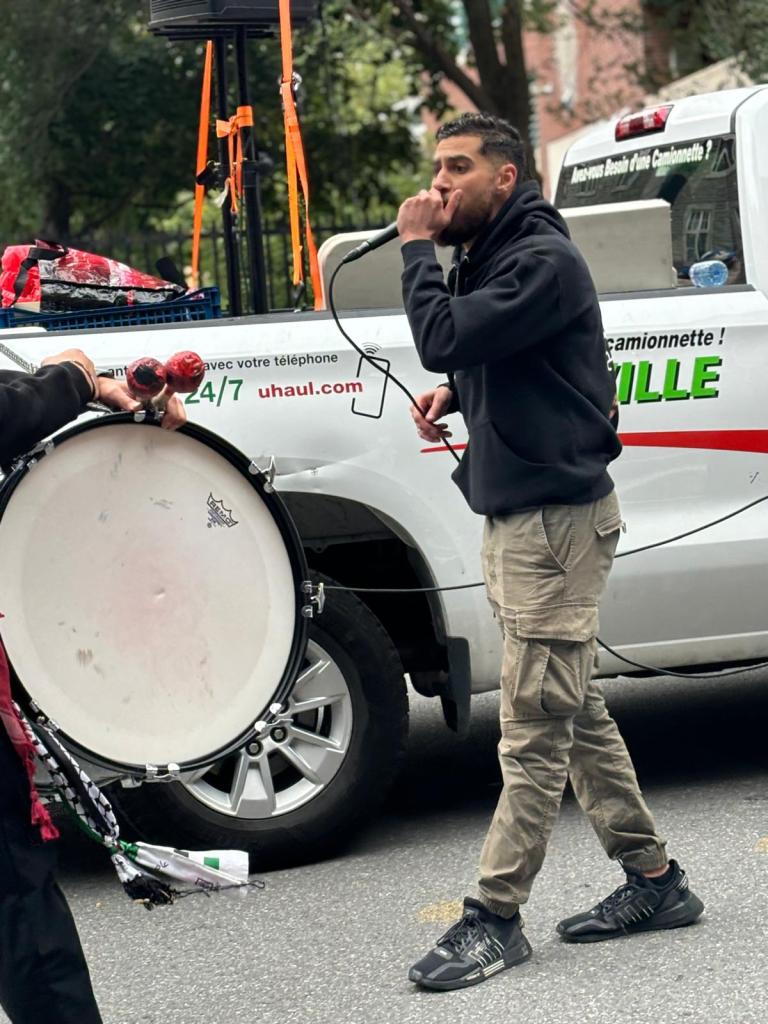
August 10th – 300 + Days of Rage: National March on Parliament, Ottawa, ON.
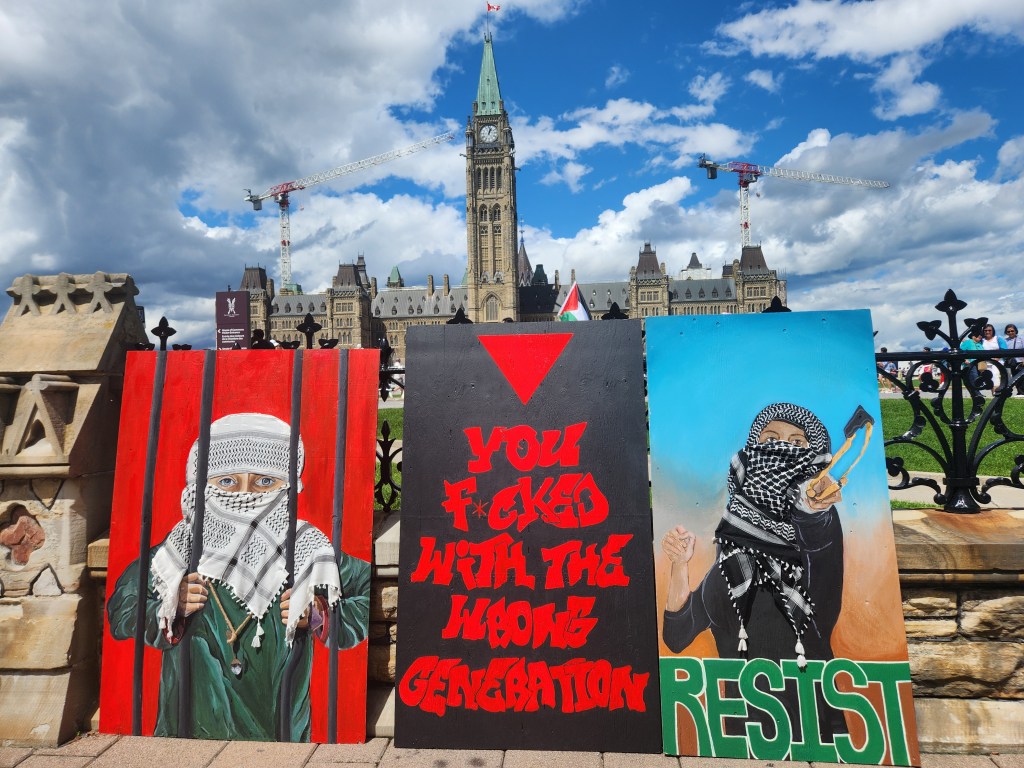
If there is one chant that has made its way to a number of protests across Canada, and even across various cities in the world, it’s the French chant that goes : “So-so-so solidaritė avec, avec, avec la Palestine.” (So-so-so solidarity with, with, with Palestine.)
Whether you’re proficient in the French language or not, it doesn’t matter. Once the first syllable of the word “solidaritė” is uttered, chanters are crouching, bouncing on their heels, preparing to spring as high as they can once the crowd joins in.
The best display of this chant’s power would be during the second national march on Parliament organized in 2024 on August 10th. The first march was held on 9 March 2024.
Montreal4Palestine, along with Ottawa4Palestine, and Liberate Palestine 48 (LP48 – formerly GTA(Greater Toronto Area) 4 Palestine) joined forces to rally up all Palestine supporters across Canada to march on Parliament, demanding a ceasefire, and condemning the genocide that had reached its 300 days mark.
Under a dimly lit tunnel in the city of Ottawa, a booming crowd gathers to hear M4P’s Mahmoud Khalil start the chant.
Drummers hold onto their leather head sticks, waiting for the right moment to strike as the solidarity cry climbs one decibel after another. Only the percussionist, as well as the protesters, are following Khalil’s change in volume and speed.
The buildup is truly excellent, creating momentum by starting the chant in a lower, slower register for it to all boil over in a sonic boom. The amalgamation of chanters, crowd cries, and intense drumming was bouncing off the tunnel walls in a perfect reverb – the power of the people in a nutshell.
“The drum is liberating, it frees your soul and gives purpose to your protest contribution,” says Ahmad Jarrar Hajahmad. “After you get used to the rhythm, it becomes second nature. For example, the drum effect of [the aforementioned chant] has evolved. We got used to how we normally drum to it, but now there are extra intermediate beats you can hit to truly amplify the chant. We don’t drum when the chanter is chanting, and we drum to amplify the sound and responses from the crowd. The timing of when to drum is what creates the synchronization and cleanliness of the beat.”
Ahmad Jarrar Hajahmad is one of the founders of Liberate Palestine 48, formerly dubbed GTA4Palestine and originally founded as GTA Palestinian Movement in 2021, following the Sheikh Jarrah protests. The movement is based in Toronto, ON.

Much like Montreal4Palestine, Liberate Palestine 48 didn’t incorporate drums into their protests before the winter of 2024, with Jarrar being one of their recent players, with no prior experience.
“I don’t have any drumming experience, but I do have protesting experience,” Jarrar says. “I learned through demonstrations, through trial and error. I mean, you just gotta stay confident and simply go for it. Week after week, you become attuned with every beat and every chant. You become familiar with the way and speed of every chanter. You just gotta go with it and you’ll eventually get the right rhythm.”
The bass drums used by the Toronto-based organization are part of a Macgyver drum set, known for being heavy instruments, oftentimes wood-base, and are turned and styled to be double-faced, with added straps so drummers are able to march alongside the chanters.
As of July 2024, Liberate Palestine 48 have more than 13 drummers in their ranks, but no more than 2 or 3 are needed during protests, in order to maintain the delicate balance between the chanters and the drummers.
“[Being a drummer] is a dedicated role,” Jarrar says. “When the drummers drum while the lead chanter is chanting, that throws off the crowd. It’s okay to do so but whenever the chanter says a new chant, that’s when we allow the crowd to hear it. But we drum on the second repetition from the crowd. We only amplify the voices of the crowd. If other drummers mess up, it messes up with the drumming of the whole squad. So we keep eye contact and speak with eye language, to take it easy on the left hand or right hand or full halt. So we keep a nonverbal communication and overtime you just get used to every person and how they drum. Week after week, you just become used to it and there is only improvement from here.”
Grassroots movements like M4P, Ottawa4Palestine and Liberate Palestine 48 believe in upholding the non-negotiable principles of the Palestinian people, otherwise known as the Thawabet.
Thawabet (plural of thabet) is an Arabic word that literally translates to “constants.” For Palestinians it generally refers to the red lines of the struggle, demands on which there can be no compromise and which have acquired a certain sanctity over the decades of struggle. They are a set of supra-constitutional principles formulated by the Palestinian National Council of the Palestinian Liberation Organization (PLO) in 1977.
These organizations also strive to remain loyal to their Islamic core values, their faith being the main pillar of their cause.
Which begs the question: Is playing the drums Haram?
There is a constant debate among Muslim scholars in regards to music, and its nature. Some scholars believe all kinds of music to be haram, while others are more selective with what they consider prohibited. The differing views and discourses all begin with a verse from the 31st sūrah (chapter) of the Qur’an, the Luqman sūrah .
The verse goes (translated from Classical Arabic): “Among them, there are those people who purchase idle tales without knowledge and without meaning and they mislead the people away from the path of Allah and they ridicule the path of Allah. These are the people who receive a humiliating punishment.”
Many tafseers (interpretations) have derived from this verse, with the conclusion being that music is only haram if it encourages people to sin, or takes them away from their spiritual purpose.
As Shaykh Abdur Rahman al-Sa’di (teacher of Shaykh Ibn Uthaymeen) explained in his Tafseers: “This includes all manner of haram speech, all idle talk and falsehood, and all nonsense that encourages kufr and disobedience; the words of those who say things to refute the truth and argue in support of falsehood to defeat the truth; and backbiting, slander, lies, insults, and curses; the singing and musical instruments of the Shaytaan; and musical instruments which are of no spiritual or worldly benefit.”
And how does that apply to musical instruments, specifically the drums?
According to a tafseer of a series of ahadith (reports) told by Sahih al-Bukhariby, interpreted by Indian Islamic public orator Dr. Zakir Abdul Karim Naik, while most instruments are forbidden in Islam, the drums, more specifically the duff is permitted, as well as the tambourine.
Drums are permitted in Islam in these conditions:
- On Eid, celebrating the end of Ramadan.
- If you’re a Masaharati, beating your drum around the neighbourhood to wake the people up for suhoor (dawn, before the day starts to eat before beginning your fast.)
- At weddings.
- When one has been away returns.
One specific condition is applicable to the protestors on the streets as well, which is the use of drums in times of war.
“In times of war, they had an army of drummers coming at the enemy and that’s freaking terrifying if you think about it,” Jarrar says. “And we kind of utilize that in demonstrations. Islamically, protesting is considered an act of war, like calling for the masses. There is the physical act of war and there is your own war here in the West. Similarly, we kind of mimic that state of thinking. So we purify our intent, and we believe that we are drumming for the sake of rallying people for war, rather than we’re just there for fun.”
“The drums add a huge impact to the protests, they give a certain vibe,” Khalil says. “They give energy, they keep the people going. Just like during wars back in the day, they used to bring out drums to keep everyone’s morale up and even sometimes to signal firing and what not. Which is what happens during protests as well, because it gives more of a rhythm to the chants that we’re doing, and keeps the people more energized. There is definitely a change in volume on days that we have the drums and on days that we don’t.”
John Norris writes in his book Marching to the Drums : “Over the centuries, drums have evolved to become symbols of inspiration, high morale and to signal victory. They have often been used to rally troops in one final effort rather than giving up.”
Indeed, that seems to be the case in modern day Montreal as Khalil confirms that on the rare days where drums aren’t included in demonstrations, people lose their energy much faster, are out of sync with one another, and off beat as well. Whereas on days where the drums are present, they have something that leads them and keeps them moving on their feet.
“We are out there with a lot of rage and a lot of anger,” Khalil continues. “We are here to leave an imprint as if we were in a war, and we truly have been in a war for 76 years. Now, from an aspect of how you utilize [the drums], that’s where to me, as a Muslim man, it becomes a question of haram or halal. For example, when we pray, when there is a duaa (supplication) no one is drumming because it is a time of prayer. The drums are used to enrage, to awaken an anger, to motivate people, not to entertain.”
It comes as no surprise to anyone that organization groups led by Palestinians would be emblems of steadfastness and resilience.
Montreal4Palestine, Ottawa4Palestine, and Liberate Palestine 48 offer people a sense of community and understanding, inspiring many to pick up flags and signs and take over the streets to express frustrations and anger.
After a year of weekly protests, relentless actions, and consistent efforts, the genocide remains ongoing and demands have yet to be met. Nevertheless, they persevere, marching to the powerful drum beats with unwavering faith, on the road to total liberation.
 Busybee's Playlist
Leave a comment